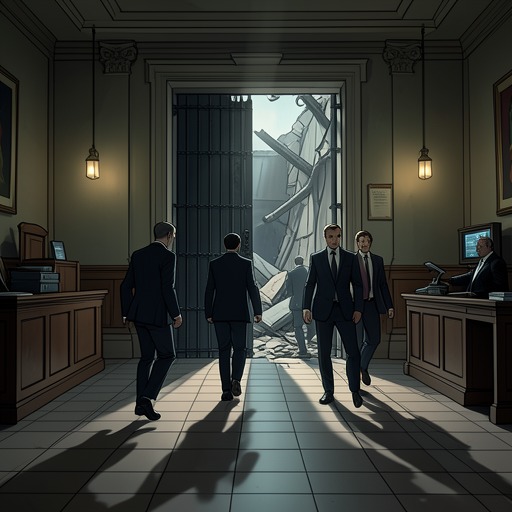
Great Benefit headquarters
The RainmakerGreat Benefit headquarters is the Cleveland-area corporate site where Rudy Baylor encounters the disparity between Great Benefit’s institutional power and his own precarious position as a young lawyer. Far from the gleaming monument to prosperity he had imagined, the building is an anonymous complex whose boardroom becomes the scene of a discovery dispute over missing witnesses and concealed claims records.
Setting and Appearance
The headquarters stands at 5550 Baker Gap Road, in an affluent Cleveland suburb shaped by white flight. From the street, there is no Great Benefit sign, fountain, or row of flagpoles. Instead, the address marks a large, five-story complex of square, interlocking blocks, faced in white cement and black-tinted windows. Its modernity does not make it imposing in the conventional corporate manner; the building appears awkward and difficult to identify.
Inside, a small foyer has plastic potted plants and a receptionist. Bronze logos identify three companies there: PinnConn Group, Green Lakes Marine, and Great Benefit Life Insurance. Their precise relationships are not apparent from the lobby. Great Benefit is owned by PinnConn, a privately held corporation whose owners are difficult to identify, but the headquarters’ shared premises leave the corporate connections visually and organizationally obscure.
The Corporate Interior
After being met by Paul Moyer, Rudy is led through corridors and an elevator to a boardroom on the fourth floor. The room’s long, shiny table is surrounded by roughly fifty leather chairs; a chandelier hangs above it, with a bar and a spread of coffee, biscuits, and bagels at one end. At least eight corporate and defense representatives are gathered there when Rudy arrives, including Jack Underhall, Great Benefit’s in-house lawyer and designated corporate spokesman.
The room’s scale and arrangement make the imbalance tangible. Rudy has traveled from Memphis by Greyhound, while his opponents arrive rested after flying in; he reaches the boardroom tired, with a wrinkled shirt, facing a group that has had a comfortable evening and a night’s sleep. The furnishings and the gathered legal team place him inside the insurer’s domain, but the court order gives him authority over the order of depositions and the witnesses who must be available.
The Deposition Dispute
Rudy refuses to begin with Underhall, as the defense prefers. He asks instead for Jackie Lemancyzk, a claims handler, and for the claim file, which the court had ordered Great Benefit to produce. The company says Lemancyzk has left and that Tony Krick, a junior claims examiner, is also gone; Rudy learns that a third listed witness, Russell Krokit, is unavailable as well. Great Benefit says Lemancyzk resigned and Krick was downsized. The timing, shortly before the depositions, leads Rudy to suspect that employees have been removed to keep them from speaking with him.
The five-inch file the company produces is missing the Stupid Letter, a document previously given to opposing counsel by Dot Black. Rudy had marked the copy three times with the word COPY, while keeping the original in his own files; its absence from the headquarters file allows him to identify the omission. He calls Tyrone Kipler, who orders Rudy to depose Underhall and investigate the witness departures, and plans a later hearing on the missing witnesses and documents. The headquarters thus becomes the setting for an immediate test of whether Great Benefit will comply with the court’s discovery orders.
Corporate Practices and Significance
The records associated with Great Benefit’s claims operation reveal a system in which claims and underwriting pass files and instructions between departments. Cooper Jackson explains that the process could keep an insured waiting through repeated denials and reviews, while the company’s Section U manuals direct the departments to deny claims and defer payment. At headquarters, Jack Underhall gives Rudy an account of the company’s structure and produces resignation letters for two of the absent employees, but the corporate explanations do not settle Rudy’s concerns about the missing witnesses or the omitted letter.
The building’s function is therefore more revealing than its appearance. Great Benefit’s headquarters houses overlapping corporate names and departments, while the claims process disperses responsibility across internal divisions. In the Black case, that institutional arrangement meets the court’s demand for specific records and accountable witnesses. Later, the company’s financial statements become part of Rudy’s trial argument: using Great Benefit’s own figures, he presents the jury with a total of $475 million in cash, reserves, and undistributed surplus, against an admitted net worth of $450 million. The corporate site stands at the center of a conflict over who can see the company’s records, who can be made to answer for its decisions, and whether its resources can be made to deter further denials.